Updated July 2026
Best Sandals for Flat Feet
Warm-weather footwear is where a lot of people with flat feet quietly give up on support for a few months a year. It doesn't have to be that way — these sandals actually hold an arch shape instead of going flat under your foot.
This post contains Amazon affiliate links. We may earn a commission on qualifying purchases at no extra cost to you. See our
affiliate disclosure.
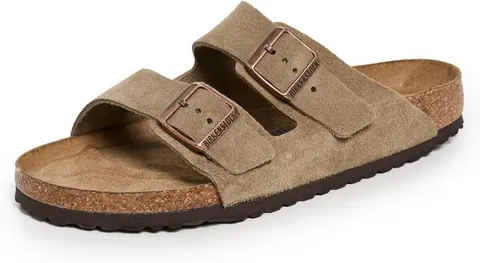
The Arizona's cork footbed is molded with a genuine arch contour, not just a flat platform with a strap on top. It's firm at first — genuinely firm enough that some people find the first week uncomfortable — but it gradually molds to your foot without losing its underlying structure.
What we liked
- Real arch contour, not a flat footbed
- Adjustable double straps accommodate different foot widths
- Cork sole holds its shape for years with normal use
Drawbacks
- Break-in period is real — some blistering is common in week one
- Not ideal for very rigid flat feet that don't tolerate firm arch pressure
- Cork sole is not fully waterproof
Who should buy it
Anyone who wants real structure and is willing to tolerate a short break-in period.
Who should avoid it
Anyone needing sandals with zero break-in for an upcoming trip, or a very rigid flat foot sensitive to firm arch pressure.
Read our full Birkenstock Arizona review →
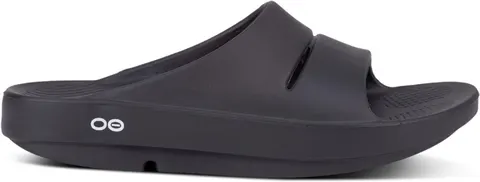
Where the Arizona asks for patience, the OOahh is comfortable from the first step. The foam is noticeably softer than a cork footbed, but it's still molded with an arch shape rather than being flat, and the material absorbs impact well — a reasonable trade if you don't want any adjustment period.
What we liked
- No break-in period at all
- Excellent shock absorption for tired feet
- Lightweight, easy to travel with
Drawbacks
- Less structured support than the Arizona's firmer cork footbed
- Foam construction looks and feels more "recovery slide" than everyday sandal
- Not as durable long-term as a cork sole
Who should buy it
Anyone who wants immediate comfort with no adjustment period, especially after workouts or long days.
Who should avoid it
Anyone wanting a sandal that passes for dressier casual wear, or needing maximum structure.
Read our full OOFOS OOahh review →
What to look for in sandals for flat feet
- A contoured footbed, not a flat one. Flip the sandal over or press into the footbed — if it's uniformly flat, it's not offering real arch support regardless of marketing claims.
- An adjustable strap system. Flat feet often come with a wider forefoot, and adjustable straps let you fine-tune the fit rather than relying on a single fixed size.
- A secured heel, if you'll walk long distances. Backless slides are fine for short errands, but a back strap gives more stability for longer days on your feet.
Don't let sandal season undo your shoe progress
If you've found a supportive everyday shoe that helps your feet, it's worth applying the same standard to your sandals rather than treating warm-weather footwear as an exception. See our
best shoes for flat feet guide for the same approach applied to closed shoes.
Frequently asked questions
Are flip-flops bad for flat feet?
Most standard flip-flops offer little to no arch support and require your toes to grip to keep the sandal on, which can add strain over a full day of wear. They're not automatically harmful for occasional short wear, but they're a poor choice as your primary summer footwear if you have flat feet.
Can I use my own orthotic insole in sandals?
Some sandals have a removable footbed that can be swapped for a thin orthotic, but many sandals, especially strap-style designs, have a fixed, molded footbed that can't be replaced. Check the specific product before assuming you can customize it.
Do supportive sandals really need to cost more?
Not necessarily, but genuine arch support (a contoured, semi-rigid footbed) usually costs more to manufacture than flat foam, so budget sandals rarely offer real structure. It's reasonable to spend more on sandals than you might expect, especially if you'll wear them daily in warm weather.